
Online Doctor Consultation in Europe: How It Works, What It Costs, and What to Expect
An online doctor consultation lets you speak with a licensed physician by video, phone, or messaging instead of visiting a clinic in person. Across Europe, this has become a routine way to get a diagnosis, a prescription, a sick note, or medical advice — often within the same day, in your own language, from wherever you happen to be.
If you're weighing whether to book one, here's what actually matters: how the process works, what an online doctor can and can't do, how it differs by country, what it costs, and how to make sure the doctor you're speaking to is properly licensed.
What an Online Doctor Consultation Actually Involves
A typical consultation follows a simple pattern:
- You describe your symptoms or reason for the visit when booking.
- You connect with a doctor at the scheduled time, usually by video call.
- The doctor asks questions, may ask you to show a rash, wound, or affected area on camera, and reviews any history you've shared.
- You receive a diagnosis, advice, a prescription, a referral, or a medical certificate, depending on what's appropriate.
The whole process is built around the same clinical judgment a doctor would use in person — the difference is the delivery method, not the standard of care. You can book an appointment directly once you know what type of consultation you need.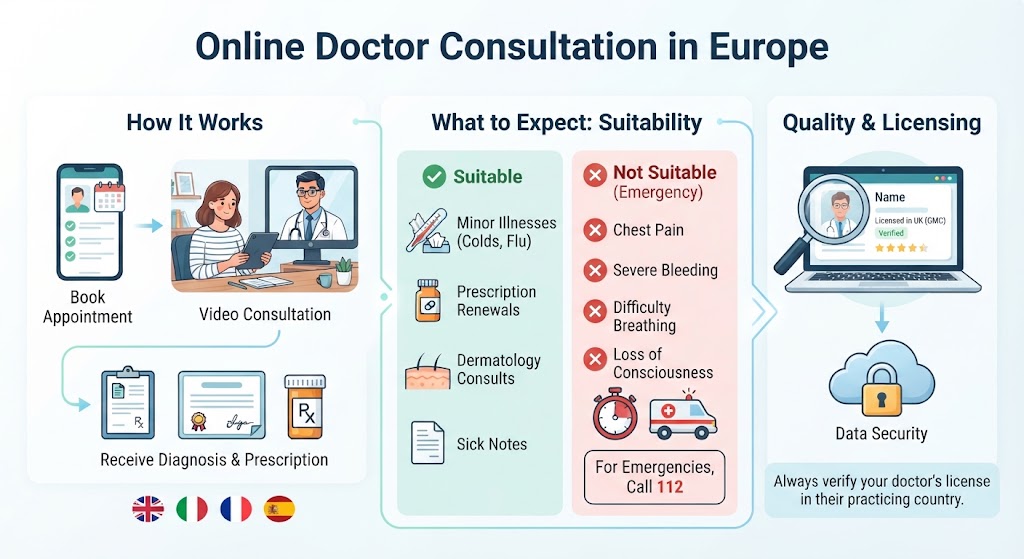
What Can Be Treated Online — and What Can't
Online doctors are well suited to:
- Common infections (respiratory, urinary, skin, ear)
- Prescription renewals for ongoing, stable conditions
- Sick notes and medical certificates
- General health advice and minor injuries
- Follow-up consultations after an existing diagnosis
- Sexual health, women's and men's health concerns, and dermatology issues that can be assessed visually
They are not appropriate for medical emergencies. Chest pain, difficulty breathing, severe bleeding, signs of stroke, loss of consciousness, or any symptom that feels sudden and severe needs immediate in-person care — call your local emergency number (112 across the EU, 999 in the UK) or go to the nearest emergency department. A responsible online doctor will tell you the same thing and redirect you if your symptoms suggest something urgent.
How This Works Differently Across Europe
Telemedicine is legal and regulated throughout the EU and UK, but the practical details — prescriptions, sick notes, and language — vary by country.
Italy. Doctors practicing in Italy are registered with the local Ordine dei Medici. Electronic prescriptions (ricetta elettronica) can usually be sent straight to a pharmacy, and many services also offer consultations in English for expats and tourists. If you specifically need an English-speaking doctor while in Italy, this guide breaks down how to find one.
United Kingdom. UK-registered doctors must appear on the General Medical Council (GMC) register, which you can check yourself on the GMC's public website before any consultation. Private online GP services in the UK commonly issue prescriptions and fit notes (sick notes), and many patients use them precisely because same-day NHS GP appointments can be hard to get. More detail on this route is covered in the private GP guide for the UK.
France. French telemedicine is formally regulated, and doctors are listed with the Conseil de l'Ordre des Médecins. Consultations can result in a standard prescription (ordonnance) or a work-incapacity certificate. For English speakers living in or visiting France, this overview explains how the process differs from the standard médecin en ligne route aimed at French speakers.
Across all three countries — and elsewhere in Europe — the same core principle applies: a legitimate online doctor should be verifiably licensed in the country where they're practicing, and you should be able to check that registration independently rather than taking a website's word for it.
Prescriptions and Sick Notes Online
Two of the most common reasons people book an online doctor are prescription renewals and medical certificates.
- Prescriptions. For stable, ongoing medication (blood pressure, contraception, thyroid treatment, and similar), online renewal is usually straightforward. New prescriptions for controlled or higher-risk medications are handled more cautiously, and a responsible doctor may ask for more history or decline if an in-person exam is genuinely needed. How e-prescriptions work is worth reading before you book if this is your main reason for the appointment.
- Sick notes. Most European countries accept a medical certificate issued after a video consultation, provided the issuing doctor is licensed in that country. Requirements for employers differ, so it's worth checking your employer's or country's specific rules. This guide to online sick notes covers what's typically required.
Choosing a Licensed Online Doctor
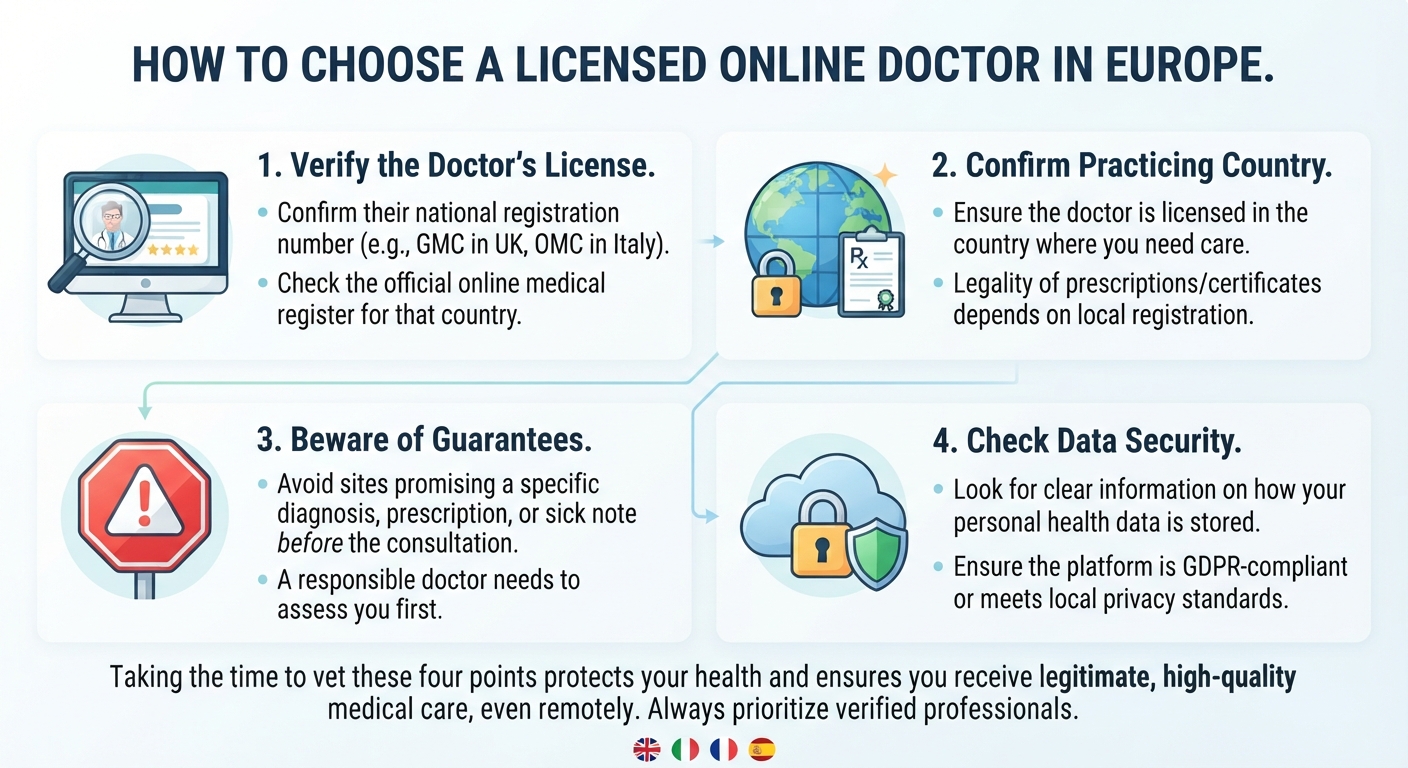
Because telemedicine is largely unregulated in terms of who can build a booking website, the responsibility for checking a doctor's credentials often falls on the patient. Before booking anywhere, it's reasonable to:
- Confirm the doctor's registration number and check it against the relevant national medical register
- Look for clear information about where the doctor is licensed to practice (this affects whether they can legally prescribe or issue certificates for your country)
- Avoid any service that guarantees a diagnosis, a specific prescription, or a sick note before a consultation has actually taken place
- Check how your data and consultation records are stored and who can access them
A more detailed walkthrough of this vetting process is available in how to choose a licensed online doctor. You can also see doctor profiles directly on the doctors page.
What It Costs
Pricing for private online consultations in Europe generally reflects three things: the doctor's specialty, the length of the appointment, and whether a same-day or after-hours slot is needed. Straightforward GP-style consultations tend to sit at the lower end of the price range; specialist consultations, longer appointments, and urgent same-day bookings typically cost more. Current pricing and package details are listed on the offers and packages page rather than repeated here, since prices change and are easy to check directly.
When to Use an Online Doctor vs. Going In Person
Online consultations work well when your issue can be assessed through conversation and visual inspection, or when you need something administrative like a renewal or certificate. In-person care is still the right call when a doctor needs to physically examine you — listening to your chest, palpating your abdomen, taking bloods, or assessing an injury that needs hands-on evaluation. A good online doctor will tell you directly if your case falls into that second category rather than trying to manage it remotely regardless.
Frequently Asked Questions
Is an online doctor consultation as reliable as an in-person visit? For the many conditions that don't require a physical examination, yes — the clinical reasoning is the same. For conditions that do require hands-on assessment, an online doctor should recognize that and refer you onward rather than guess.
Can an online doctor issue a prescription valid in my country? Only if they're licensed to practice in that specific country, since prescribing rules are tied to national registration. This is exactly why checking a doctor's license location matters more than checking a website's country domain.
How fast can I get an appointment? Same-day and 24/7 options exist for many common issues — see same-day online doctor availability and round-the-clock telemedicine options for how quickly urgent, non-emergency issues are typically handled.
I'm a tourist or expat — can I still use a local online doctor service? Yes, and this is one of the most common uses of telemedicine in Europe. This guide for expats and tourists covers the practical details, including language options and how prescriptions are handled when you're not a long-term resident. For readers comparing options more broadly across the region, telemedicine services across Europe is another resource worth a look.
Next Step
If you already know what you need — a prescription renewal, a sick note, or a general consultation — you can go straight to booking an appointment. If you're still unsure which type of consultation fits your situation, the FAQs page and country-specific information are good places to check first.